
The challenge of developing ‘well’
Across our region, buildings are left to decay – not because nobody wants to develop them, but because the numbers don’t work in the usual way. The ‘viability gap’ – between how much something costs to refurbish well (with the longevity of the building – and planet – in mind), and how much it’s worth when finished – needs plugging with additional funding, exactly as it is for volume housebuilders. Community organisations do the same work and serve the same need – and often deliver it more meaningfully, with more focus on local needs – but are held to a different standard.
The big difference is where the money ends up. Volume housebuilders receive grant subsidies, develop their sites and then distribute the profit to shareholders. We’re not asking for more – just the same opportunities.
There are many communities across the UK – particularly across the North – that face similar challenges. Yet the area we live and work in is uniquely challenged by a combination of historically low market values and significant competition from outside developers who see our proximity to Anfield Stadium as a guarantee of high rental yield through Airbnb and HMO-style properties. This compounds the difficulties faced by any organisation working to create truly community-led, grassroots development: by the people, for the people.
“Our aim is to develop our neighbourhood ‘well’,” says Two Up Two Down coordinator, Tom Murphy. “In a way that works to deeply improve things for our local community, by creating genuinely affordable, warm, healthy, secure, environmentally friendly homes, which remain so into the future.”
That ambition is shared by community-led organisations across the country. But ambition alone doesn’t close the gap.
The numbers don't lie
To put things into perspective, we compared the cost of a deep retrofit of a two-bed brick terraced home in our community with very similar properties in south Liverpool and in Cambridge. The figures are a stark indicator of just how inequitable the current systems are – and how difficult they make it to develop well in lower-value neighbourhoods.
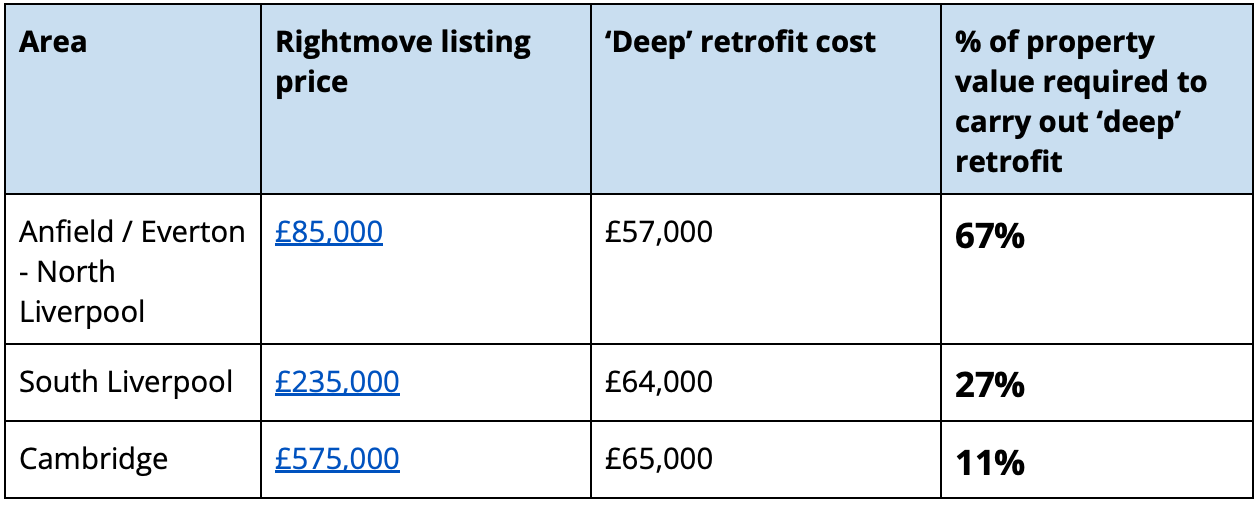
Table comparing cost of ‘deep’ retrofit in 2-bed, brick terraced homes in different locations across the UK. The calculations use a figure of £1000/sqm (a benchmark figure compiled from numerous sources).
Note: these figures do not take into account any structural / remedial work required to make the houses ‘retrofit ready’, ensuring a fairer comparison as the relative condition of the properties does not come into account.
The maths is brutal. The same work costs roughly the same wherever you do it, but the values against which that work is assessed – and the grants and loans that flow from those assessments – vary enormously. Communities in the north are, in effect, penalised for the historical underinvestment that made them low-value in the first place.
The problem isn’t just financial, it’s structural – and it starts earlier than most people realise.
Louise Cross is partnership and regeneration coordinator at Make CIC, which has ambitions to develop low-cost housing for the artists and makers it supports in Birkenhead. She describes the crux of the issue: “There’s only so much work you can do if it’s not backed by a funding pot,” she says. “And having that patience – or that ability to keep pushing and nudging it forward when juggling it with other projects which keep the lights on – means development projects never kind of get off the ground.”
Without early-stage risk funding – for things as basic as a ground survey – projects stall before they can even be properly assessed for feasibility. Yet funders tend to favour projects that have already demonstrated viability. The result is a chicken-and-egg problem that community organisations navigate largely on goodwill and stretched capacity.
The scale problem compounds this further. To access significant public funding, you typically need to demonstrate organisational weight. But building that weight consumes everything you have. Louise says: ”You’ve got to be able to have done several other things first. We wouldn’t be able to do it if we weren’t running the core part of Make to build that. And even then, that parallel income – the thing that gives you security for lenders or funders – is the same thing that uses all the capacity in the organisation.”
Meanwhile, meanwhile use
One response to these structural barriers has been meanwhile use – the occupation of spaces on a short-term basis to build evidence, community relationships and the business case needed to eventually pursue asset transfer. It’s pragmatic, patient and, in many cases, the only viable route forward.
Make’s makerspace in Huyton is an example of this approach in the city region. By demonstrating sustained occupancy and community engagement, organisations can gradually shift the conversation with councils and funders from aspiration to evidence. As Louise notes, the long game is necessary: “The council wouldn’t be able to say yes to a community asset transfer if we can’t say, okay, well, we’ve been at 97% occupancy for X amount of years – and we’ve offered events that brought in this amount of engagement. It’s slowly bringing culture back to the high street and keeping people in community and culture alive during the massive development work that’s happening.”
It works – but it asks a great deal of small organisations operating without the reserves, staffing or infrastructure that statutory and private bodies take for granted.
Community organisations are often doing genuinely innovative work – Make is collaborating with WeCanMake in Bristol around low-carbon, community-built housing using the Multimax model. The sector tends to share knowledge openly, in contrast to the IP-hoarding approach of the private sector and that openness is one of its great strengths.
But it also exposes gaps. When you’re breaking new ground, you need to know things that nobody has had cause to document yet – VAT implications are just one costly example. And unlike larger developers with specialist teams, community organisations have to become experts in everything, often at the point of needing to act:
“If we’re being innovative, you’ve got to suddenly know everything, rather than having these systems in place. We don’t have the capacity to be an expert in all areas of a new project,” admits Louise. The sector compensates through collaboration and knowledge-sharing. But that only stretches so far when the underlying funding culture consistently prioritises the ‘sexy’ project over the necessary groundwork – and when councils remain deeply risk-averse.
A level playing field
We’re not asking for special treatment – we’re asking for the same conditions that are extended, as a matter of course, to volume housebuilders who extract profit from the same communities we serve.
That means early-stage risk funding. It means Red Book valuations (property appraisals carried out by a RICS Registered Valuer) that aren’t only reflective of historical underinvestment. It means funding timescales that allow for the slow, careful, community-led work that genuinely affordable, genuinely sustainable development requires.
The buildings are there, often sitting neglected. And the will is there too, within the communities that have lived alongside them for years. What’s missing is a system willing to back them on equal terms.